

If you know someone that you think might like this post, please feel free to share this, it would help me carry on bringing you more news and fintech trends.
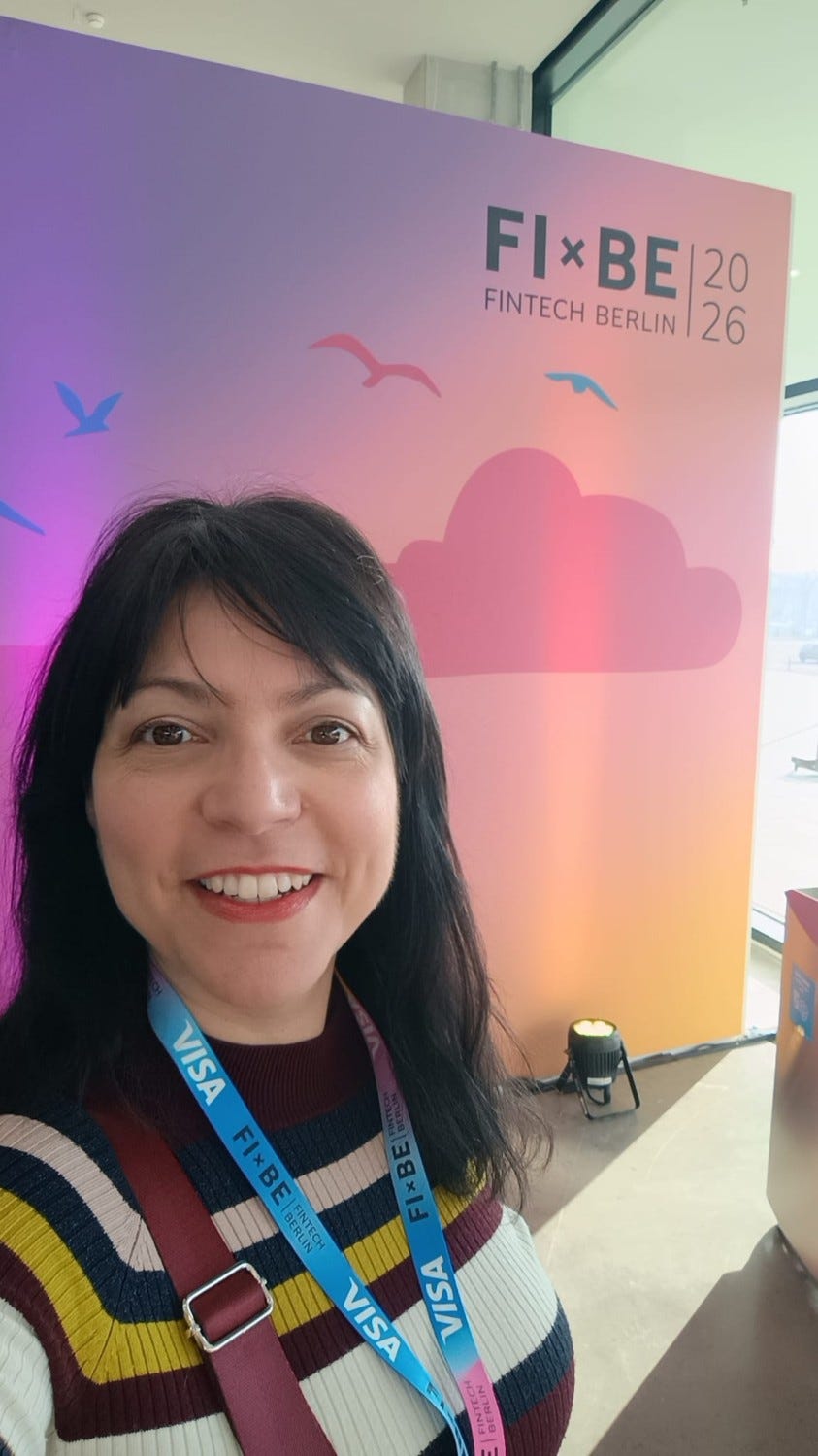
First stop at FIBE Berlin: badge on, coffee in hand, standing in front of the FiBE 2026 wall with the Visa lanyard still slightly twisted from registration.
That moment where the event hasn’t fully started for you yet, but the signals are already there. The branding, the partners, the mix of people walking past. You can tell quickly what kind of conversation you’re stepping into.
This year, one thing was impossible to miss. AI was everywhere.
Not in a loud, overhyped way. In a quieter, more embedded way. It showed up across panels, conversations, but always with the same undertone.
Here is what I saw:
The AI conversation has matured.
AI was everywhere across FIBE. That part isn’t surprising.
What’s changed is the tone. The conversation has moved past early experimentation. Builders are no longer asking if they should use AI. They are working through where it fits, what it replaces, and what risks it introduces.
On stage, the narrative sounded structured. AI improving underwriting, automating support, strengthening fraud detection. There was a sense of inevitability.
There’s also a gap between how agentic AI is discussed and how it’s being used. On stage, it’s framed as orchestration and autonomy, with systems making decisions end to end.
In practice, most implementations are still narrow, especially in regulated flows. They support decisions, they don’t make them alone.
The AI conversation has matured. But deployment is still gated.

Infrastructure is the real story
If you zoom out from the AI noise, a different pattern emerges.
FIBE continues to be less about front-end innovation and more about what sits underneath. Payments rails, compliance tooling, orchestration layers, identity, data flows. The parts of the stack that are harder to see but harder to replace.
You could see this in how companies position themselves. Fewer pure consumer plays. More infrastructure narratives. More emphasis on integration rather than disruption.
There’s also a political layer running through it.
European sovereignty is no longer a side topic. It shows up in conversations about payments, cloud, data, and increasingly AI. The underlying question is consistent. How much of the financial stack can Europe afford to outsource?
That tension is shaping where infrastructure gets built and who builds it.
Regulation is a competitive variable
Regulation wasn’t treated as background noise at FIBE. It was part of the strategy discussion.
MiCA, PSD3, DORA kept coming up, not as checklists but as forces that shape product decisions and timelines.
The mood around this wasn’t uniform.
There’s fatigue. Teams are dealing with overlapping frameworks, unclear timelines, and rising compliance costs. Especially for smaller players, the burden is real.
At the same time, there’s a growing sense that regulation can be an advantage if you can absorb it.
Fintech teams treat regulation as part of the product. They build AI systems to be auditable, traceable, and controllable from day one.
There are still open questions, especially around accountability. When AI makes a mistake, responsibility is not fully defined yet. It sits between providers, operators, and regulated entities .
That uncertainty slows things down.
But it also creates a filter.
Companies that can absorb compliance early move forward with more credibility. Those that can’t are pushed into partnerships or held back.
Regulation is no longer just a constraint. It’s shaping who gets to compete.
Where the money is (and isn’t)
The funding conversation felt more grounded in a new reality.
There’s still capital in the system, but it’s more selective and more opinionated.
Infrastructure continues to attract attention. Payments, compliance, and tooling that sits inside regulated workflows. Areas where demand is stable and tied to long-term structural needs.
AI is part of that, but not as a standalone bet. Investors are looking at how it integrates into existing stacks.
Pure neobank plays don’t carry the same energy. Consumer-facing products without a clear path to profitability or differentiation are harder to justify. The bar is higher.
What investors are asking is more direct now. Where does this sit in the stack? Who depends on it? What happens under regulation?
That shift is subtle, but it changes what gets built.
What FIBE leaves open
On the plane back to Malmö, one question kept coming up.
How much of AI actually gets deployed in financial services under European regulation?
The industry is moving forward, but under constraints that don’t exist everywhere else.
That might produce more resilient systems. It might also slow down iteration in ways that are hard to recover from.
What I kept in mind
FIBE gets the balance right: strong conversations on stage, even better ones off it.
You move quickly from panels to real discussions with people actually building, regulating, and funding this space.
It feels less like an event and more like a festival of ideas and thought leadership for European fintech.
Same place next year?
If you need someone who can translate complexity into clear, strategic content, that’s the work I do.
Just hit reply - I read every message!